Saturday, March 26, 2016

August Wilson Evening with Susan

Typically, on a Friday evening, I am in jammies recovering from a scrape-me-off-the-floor physical and mental exhaustion of the teaching week. My couch is my refuge, solitude my balm. 

Thanks to a 3-day weekend reprieve, though, last night, I met up with my beloved mentor and friend, Susan, for an evening of friendship, delicious food, and August Wilson's "How I Learned What I Learned" at the Huntington Theater Company.

Susan does amazing work with the youth of Boston as the education organizer of the Learn2Teach/Teach2Learn program at the South End Technology Center at Tent City directed by none other than the venerable Mel King. In her words, she is a "community education worker & bicycler who chops vegetables, bakes pies, loves our Boston youth for their unique passions and genius!" Can you see why I love her? 

On a typical Friday evening, Susan is as likely to be hosting a group of community Makers at the Tech Lab as she is writing a grant, troubleshooting some misbehaving code or circuit, or tweaking the latest learning activity for the next workshop. Mel often tells her to leave, get a life, go do something fun (my words, but trust me, that's the essence of his meaning). 

Thus, when we solidified our plans to--GASP!--go out on a Friday night, we were both super proud of ourselves and of course looked forward to each other's company. 

We began our evening with a delicious meal at Lucy Ethiopian Cafe, a gem of a "hidden" find that nourished our bellies and warmed our souls. 

Peanut tea with 3D printed bunny, a gift from Susan, fabricated with love at the Tech Ctr:
the most heavenly concoction made from a special house recipe containing milk, honey, peanuts.

Vegetarian platter for two with injera: yum yum! We kept eating even after we were full. 

After dinner, we walked a block to the Huntington Theater Company for August Wilson's "How I Learned What I Learned," a theatrical memoir directed by Todd Kriedler, featuring Eugene Lee. Both Kreidler and Lee worked closely with AW when he was still alive, Kreidler as the dramaturg, and Lee in lead roles of several of AW's Century Cycle plays. On top of that, Constanza Romero, Wilson's widow and the executor of his estate, serves as creative consultant and costume designer for the show. In short, Wilson's spirit very much inhabits the theater and this production of his final work.

Eugene Lee gave a phenomenal performance. Charismatic and dynamic, with a stamina that blows my mind (it was a 1 hr 40 minute one-man show, no intermission--I would be toast after a single performance, if I made it all the way through, much less performance after performance, 2 on Saturdays, for an entire month), Lee breathed life into August Wilson's words, engaging the audience throughout, surprising and delighting, provoking us to confront issues of race and class that make so many people uncomfortable. Great art makes us think. It nourishes the soul. Wilson fervently believed that art could effect social change.

And for the first time in my life, I attended a theater performance whose audience was not overwhelmingly white. Wow, the audience was not all white! I couldn't play my usual game of counting how many POC because there were too many to count! As a woman noted in the post-performance audience discussion, when a theater produces material that speaks to the diverse population of the city, the people who don't usually come will come. I wanted to stand on my seat and whoop at the the top of my lungs!


The set of August Wilson's "How I Learned What I Learned": papers strung on wires to represent AW's prolific scribbles and drafts on any piece of available paper, including napkins, coasters, and scrap paper; changing video projected letters on top of the suspended papers; a deconstructed boxing ring, an arena symbolizing AW's life and journey; a desk of plywood over two filing cabinets reminiscent of an aspiring writer's modest roots; and debris strewn below the boxing ring symbolizing each of his Century Cycle plays, including a baseball mitt, bat, and a golf club.

"All you need in the world is love and laughter. That's all anybody needs. To have love in one hand and laughter in the other."--August Wilson


Friday, March 25, 2016

The time my brother gave me Thoreau as a peace offering

My brother tormented me when we were little. He was my hero, I was his albatross. While I remember him pinching me if I dared sit next to him in Sunday school, where mom dropped us off for free English lessons (a clever, clever move, I've always thought... leave it to my genius mom, a high school drop out, to hunger after giving her children opportunities she did not have to the point of dropping us off at a church that offered free English lessons for children... we were not Christian, but hey, free English lessons! But that is a different story for a different day)--

As I was saying, while I remember him shunning me, my brother remembers me chasing after butterflies and leaving behind shopping bags that were my responsibility (mom always believed in everyone pulling their own weight). Though he is only 20 months older, my brother, always the responsible eldest child, collected the shopping bags that I'd left behind, and hated me for it.

We were night and day. He was the favored child, I was (allegedly) the ill-tempered one. He was measured and calm, I was emotional and crabby. He was focused, I was a space cadet. He was responsible, I was a free spirit. He was aware of his surroundings, I was absorbed in details that took my attention away from my immediate surroundings. In other words, he was a Jedi master, and I was a nobody.

To teach me a lesson, my brother would steal my Smurfette or Chuck E. Cheese wallet to see if I noticed. To test my reflexes, he'd practice his latest martial arts moves on me without warning. My mother did not intervene. (Back to the favored child and only male status.) Once, when my uncle and aunt were visiting, my brother stealthily attacked my aunt, mistaking her for me. I was outraged when he did not get in big trouble as I had hoped he would.

It's not surprising, then, that sometime during high school, I reached my breaking point. I was sick and tired of being his unwilling whipping post, sick and tired of my parents not intervening. So, I stopped speaking to my brother.

If you ask him, he stopped speaking to me because I declared he would never, ever get into college. (That he took anything I said to heart was a revelation to me.)  

About a year and a half into our silence, in his junior year of high school, my sophomore year, completely without warning, my brother left me a present under the Christmas tree (no, really, we are not Christian), wrapped in light blue packaging paper, addressed to me in his distinctive masculine cursive. My eyes teared up as I unwrapped a Bantam Classic edition of Thoreau's Walden and Other Writings. 

Just like that the icy silence melted. 

In the time we did not speak, my brother did not stop noticing my love for the written word. Thoreau went to the woods to live deliberately. My brother's deliberate act of calling a truce changed the course of our relationship; he was far more magnanimous than his angry teenage sister.

When we met up in Europe as grad students, I saw for the first time the dark side of his favored child status: he internalized much of the burden of being the first born child, the bearer of the hopes and dreams of our parents. In childhood, I was so busy protesting the inequities between us and feeling sorry for myself that I never noticed his burden.


Thursday, March 24, 2016

I won!

At the beginning of last period today, Beth, our computer lab tech, walked into my classroom. To be honest, Beth scares me a little. For a split second, I wondered if I was delinquent in returning a piece of equipment. 

Just as I scanned my brain and determined that I did not have any overdue technology equipment in my possession, Beth handed me some cash and told me that I was the winner of this week's 50/50 staff raffle. 

I won! I won! 

Is this how Hagrid feels when he finds and devours contraband before I can stop him? SCORE! YUM! [Licks his chops.]

It was a modest $20 but I feel like a million bucks.

Hello, 3-day weekend!


Wednesday, March 23, 2016

TLC on Taco Wednesday brings back memories of gourmet lunches

When Chef Vin spotted me in the cafeteria line today, he waved me aside, whipped open the oven door behind him, reached inside with an oven mitt, and presented me with a special plate of rice and beans topped with salsa and melted cheese, with a side of green beans with garlic and sauteed mushrooms, all made from scratch. 

"I put together a veggie plate for you," he said in his usual unassuming, understated manner. (I blogged about Chef Vin here in item 3.)

I seriously almost cried.

I can count on one hand the number of people who have taken the time to cook something delicious for me in the past year: my friend Susan (Moroccan barley and chick pea salad with teriyaki tofu), my mother (shredded tofu with celery, carrots in a sesame dressing), and my sister Mimi (the most amazing homemade stuffing with cornbread, cranberry pecan bread, butternut squash, and Gorgonzola).

I love living alone, I do. But living alone means the only meals coming out of this kitchen are the ones I make. So when someone else cooks for me, I'm putty. I want to sink to my knees and wrap my arms around their legs like a supplicant. 

Today Chef Vin's thoughtfulness and TLC made me yearn for the days of elementary school when my mom and grandma would send us to school with gourmet lunches packed in thermal containers or cute bento boxes with matching chopsticks/cutlery sets. While other kids ate assorted sandwiches in their household's rotation, we enjoyed homemade maki rolls, Grandma's fried rice, pork chops with onions and rice (those were the days when I still ate meat), and so many favorites. 

Oh, those were the days. I marvel at my grandma and mom's love poured into the sustenance they created on a daily basis. How on earth did they do it? 


Tuesday, March 22, 2016

All we have is the present moment: thoughts inspired by an icebreaker

This morning's compulsory curriculum planning session began with an icebreaker: "Where do you see yourself in 20 years?"

I used to yearn toward the future, but these days I am much more interested in the present moment.

I am not reckless. I use a calendar and honor my commitments. I am adequately insured. I put money away in retirement accounts. I make extra payments on my mortgage on a regular basis. I do not let Hagrid's food run out. I take my vitamins every morning. Beyond following Suze Orman's financial advice and fulfilling my responsibilities, though, I prefer to devote my attention to being present.

The universe never ceases to amaze me in its perfect timing. Although over the years several people told me about the book called The Power of Now, by Eckhart Tolle, I did not read it until two years ago. And when I did, everything made sense. Oh, yes. This really is simple. All we have is the here and now. All the suffering we create for ourselves can be attributed to attachment to the past or worry about the future.

I'm pretty sure this book would not have interested me in the least all those years ago when I first heard about it.

Now, what matters to me is remembering to breathe. Waking up and dwelling for the first few moment of my wakefulness, before I rise from bed to begin my day, on things to be grateful for. Feeling Hagrid's warmth snuggled against my right shoulder as he occupies three quarters of the bed and I get the remaining quarter. The stillness of our morning walks at sunrise before I head off to work. The chime of an incoming text from a friend or family member whom I was just thinking about. A shared laugh.

So when it was my turn to answer the icebreaker question, I said, "In twenty years? Whatever it is that I want in twenty years is something I prefer to live by now."

I couldn't help but think of the Belgians who woke up and went about their day by riding the subway and going to the airport this morning. 


(Postscript: I just looked out and noticed the beautiful orangish glow of the almost full moon! Check it out!

Post-postscript: My icebreaker answer may not have been my only act of subversion during the meeting today....)


Monday, March 21, 2016

A Well of Tears for the Last Golden Lotuses

I have small feet. A women's size 5, youth 3.5, European 35, to be exact. And yes, I sometimes shop in the youth section of retail and online shoe stores. But it turns out that my so-called small feet would have been giant grotesque deformities had I been born 65 years earlier in China.

Although footbinding was officially banned in China in 1912, in actuality it took much longer for the millenium old practice and aesthetic to fade from favor. 

My mother tells stories of her grandmother, my great grandmother, who had bound feet, changing her foot binding bandages every few weeks. When great grandmother unwound her bandages, soaked her feet in a basin of hot water, hand washed her binding cloths, and hung them out to air dry, the children shrieked and ran from the holy pungent reek of dead skin and marinated sweat.

After my grandmother, born in 1921, was sold to distant relatives for 5 silver coins by her heroin addicted father shortly after the death of her mother (you can read about it here), she was put to work to earn her keep. An orphan girl, she was not high statused enough to have her feet bound, but her relatives did force her (out of love?) to make her own shoes at least a few sizes too small to preserve her chance at a decent marriage. My grandmother told me she surreptitiously made her shoes larger so her feet would not hurt as much, but when the grown ups noticed, they sent her right back to work making shoes that they deemed acceptable. They hurt like hell and contorted her feet.

This poem is inspired by stories passed down to me through my grandmother and my mother.


It was a gesture of love.

Around ages 5 or 6
(Sometimes as early as age 3)
A loving mother
Soaked her daughter's feet
In hot water infused with medicinal herbs
(Sometimes in animal blood)
Anointed her child's feet
With a mixture of herbs and oil
Clipped her toenails short.

Mother lovingly massaged
Daughter's perfectly formed feet, bones still soft,
Skin yet uncallused
Toes plump.

Some mothers consulted fortune-tellers
Waited for the most auspicious day
To initiate daughters
Into a life that improved
Their prospects for marriage.

Some waited until winter, when the cold
Numbed the pain a little.

But who were they kidding? 

Breaking the bones
Of a little girl's feet
Eight toes 
Smushed and bent
Inward to the sole
Held in place with a 10 foot by 2 inch binding cloth
Soaked in hot water
(So that it would shrink as it dried)
Wound over and over itself
Sewn in place
With needle and thread
Sometimes so tightly the needle went through the toes 
--Is not for the faint of heart.

(If they were lucky
The big toe
Was left to breathe alone
Unbroken.)

Daughters were forced to walk 
In their bandaged feet
Until their bones were broken
The arch collapsed into itself
The feet secreted blood and pus.
They cried
Until they understood their mothers 
Could not reverse the process
Once it had begun.

It was a lifetime commitment.

The process of reversal
Would hurt more than the initial 
Breaking of bones. Once the violence was done
There was no going back.

At first their bandages were changed
Every two days
To clean the feet of blood and pus.
Every few weeks the young girls' feet
Were squeezed into even smaller shoes.

The ideal outcome:
A 3 inch golden lotus.
A 4 inch silver lotus 
Was acceptable.

Anything larger
And you might as well jump
Into a well.


https://en.wikipedia.org/wiki/Foot_binding#/media/File:A_HIGH_CASTE_LADYS_DAINTY_LILY_FEET.jpg


To read more about Chinese footbinding, check out these sources:


Sunday, March 20, 2016

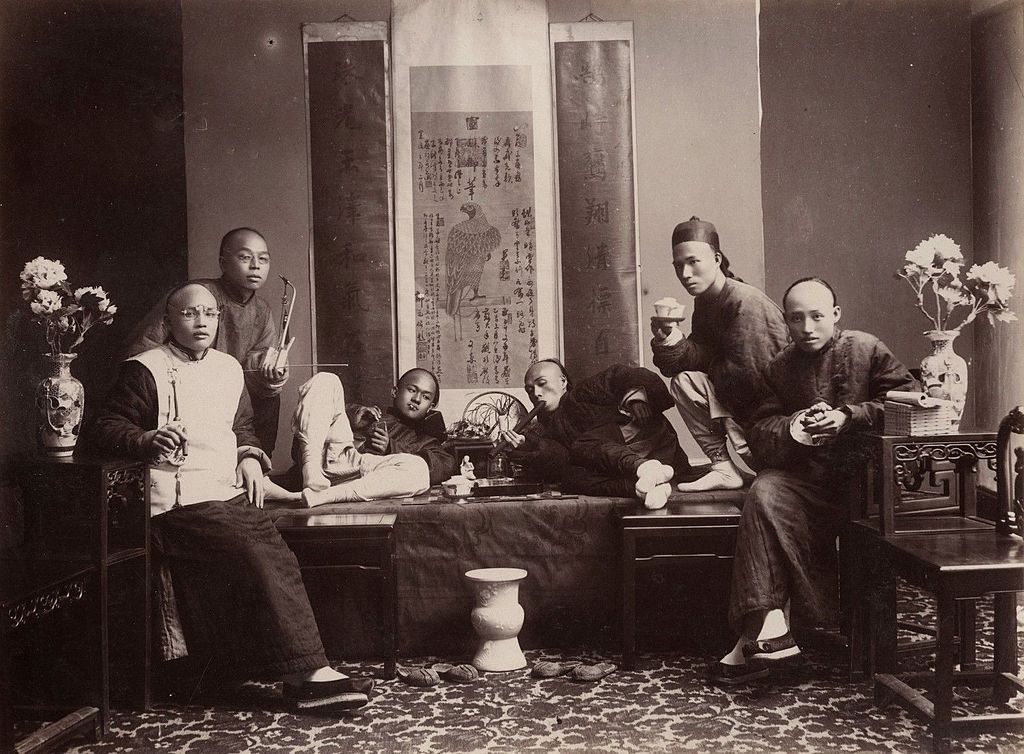
Child of the Opium Wars

https://en.wikipedia.org/wiki/History_of_opium_in_China#/media/File:China,_Opium_smokers_by_Lai_Afong,_c1880.JPG

Tea and porcelain
Were not enough.
They wanted silk and nankeen,
A canvas for pillage and plunder.

While the British loved to drink their
High tea
Imported from China and India
Eat their scones on 
Fine porcelain,

The Chinese had no use for heavy British wool.

Now the Brits
Bedecked in luxurious silk and
Beautifully dyed nankeen cotton
Were worried
As they sipped their fine imported tea--
Too much silver drained from England.

They hungered after power.
Unfettered access to trade routes and
World-class ports most 
Lucrative to England.

Their solution:
Opium
Grown in Bengal
On conquered land 
Cheaply produced
Resold at a hefty profit.

They bribed Chinese officials
Distributed free samples
Far and wide
To unsuspecting victims.

Soon millions of Chinese
Were addicted to opium.

Her earliest memory was of playing
Next to the dead body of her mother.
Mother and daughter shared
The same bed.
Daughter was too young to know 
Her mother's spirit had departed
And what was left was a corpse
Still warm
As though sleeping.

At some point the adults found the child
Playing quietly next to her dead mother.
They told her to cry, cry for your mother, 
For she is dead.

Not long after playing next to the body of
Her dead mother
Her father sold her to relatives
For 5 silver coins.

He was an opium addict
Seeking his next high.
She never saw her father again.

The young child was my grandmother.


To read more about the Opium Wars, check out these sources:


  1. The First Opium War, by Peter C. Perdue
  2. The Opium War and Foreign Encroachment (Asia for Educators, Columbia University)
  3. The Opium War's Secret History, by Karl E. Meyer